
Best ChatGPT Prompts for SEO
Best ChatGPT Prompts for SEO (2026 Complete Guide)
Search engine optimization in 2026 is no longer about stuffing keywords or copying what competitors do. SEO today is about understanding intent, moving fast, and executing with precision. If you’re still doing everything manually, you’re wasting time and missing opportunities.
That’s where ChatGPT becomes your advantage — not as a shortcut, but as a multiplier. When you prompt it correctly, you can research smarter, write faster, and optimize content in ways that align with how search engines actually work today.
This guide shows you the best ChatGPT prompts for SEO, explained clearly and designed to help you rank better — whether you’re a beginner or already publishing consistently.
Why ChatGPT Matters for SEO in 2026
Search engines reward clarity, relevance, and usefulness. ChatGPT helps you get there faster by removing friction from the SEO process.
When used correctly, it allows you to:
- Discover low-competition, high-intent keywords
- Analyze search intent before writing
- Build SEO-friendly outlines in minutes
- Improve on-page optimization naturally
- Refresh existing content without rewriting everything
The results depend on one thing only: the quality of your prompts.
1. Keyword Research Prompts That Actually Work
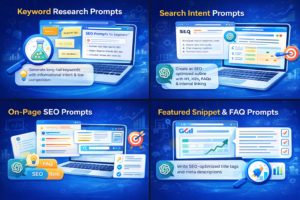
Generic keyword lists won’t help you rank. You need long-tail queries that match real user intent.
Prompt: Long-Tail Keyword Discovery
Act as an SEO strategist. Generate 20 long-tail keywords related to “[main topic]” with informational intent and low competition.
Use this when:
- Your site is new
- You want faster ranking potential
- You’re building topical authority
This prompt uncovers opportunities most tools overlook.
Prompt: Keyword Clustering
Group these keywords into semantic clusters and suggest one main article with supporting sub-articles.
Why this matters:
Google ranks topics, not isolated pages. Clustering helps you build relevance naturally and avoid keyword cannibalization.
2. Search Intent Prompts That Prevent Ranking Mistakes
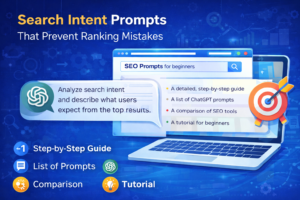
Many articles fail because they don’t match what the searcher wants.
Prompt: Search Intent Analysis
Explain the search intent behind “[keyword]” and describe what users expect to see in the top results.
This tells you whether to write:
- A step-by-step guide
- A list of prompts
- A comparison
- A tutorial
Matching intent increases rankings and dwell time.
3. SEO Content Outline Prompts
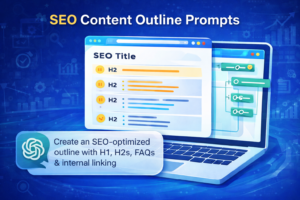
Strong structure improves readability and helps search engines understand your page.
Prompt: SEO-Optimized Outline
Create an SEO-optimized outline for “[keyword]” including H1, H2s, FAQs, and internal linking suggestions.
This ensures:
- Logical flow
- Clear hierarchy
- Better chances of featured snippets
4. On-Page SEO Prompts That Boost Performance
Small on-page improvements often lead to big gains.
Prompt: Title & Meta Optimization
Write 5 SEO-friendly title tags and meta descriptions optimized for CTR for “[keyword]”.
This helps your page stand out in competitive SERPs and increases clicks without changing rankings.
Prompt: Internal Linking Suggestions
Suggest relevant internal links for this article based on semantic relevance.
Internal links:
- Distribute authority
- Improve crawlability
- Strengthen topical coverage
5. Writing SEO Content Without Sounding Artificial
Search engines now detect low-quality, templated content. You need natural flow.
Prompt: Human-Style SEO Writing
Write this section in a natural tone using second-person perspective. Avoid repetitive phrasing and robotic patterns.
This improves:
- Readability
- Engagement
- Trust
Prompt: Paragraph Refinement
Rewrite this paragraph to improve clarity and engagement while keeping SEO intact.
Perfect for updating underperforming pages.
6. Featured Snippet & FAQ Prompts
Featured snippets can drive traffic even if you’re not ranked first.
Prompt: Featured Snippet Formatting
Rewrite this answer in a concise format suitable for a Google featured snippet.
Prompt: FAQ Generation
Generate SEO-friendly FAQs based on common questions related to “[topic]”.
FAQs increase:
- SERP visibility
- Semantic relevance
- Voice search compatibility
7. Content Refresh & SEO Audit Prompts
Updating content is often easier than creating new pages.
Prompt: Content Update Suggestions
Analyze this article and suggest SEO improvements based on current search intent and structure.
Prompt: On-Page SEO Audit
Perform an on-page SEO audit and list actionable improvements.
These prompts help you stay competitive as algorithms evolve.
Common Mistakes to Avoid
- Publishing raw AI output
- Ignoring search intent
- Over-optimizing keywords
- Skipping internal linking
- Using vague prompts
ChatGPT is a tool, not a replacement for thinking.
How to Use These Prompts Effectively
Follow this workflow:
- Choose one main keyword
- Analyze intent
- Build a strong outline
- Write naturally
- Optimize and refine
Consistency beats volume every time.
Final Thoughts
SEO success in 2026 comes from clarity and execution, not shortcuts. With the right ChatGPT prompts, you can publish smarter, scale faster, and stay ahead without burning out.
These prompts are not theory — they’re practical tools you can apply today.