AI Prompts for Handling Difficult Clients
AI Prompts for Handling Difficult Clients: How to Stay Professional, Calm, and in Control. Dealing with difficult clients is one of the most emotionally draining parts of running a business. You open your inbox, see that name, and immediately feel tension in your chest. The message might be aggressive, passive-aggressive, confusing, or full of unrealistic demands. You know you need to reply but the wrong words could escalate the situation, damage the relationship, or cost you the client entirely.
This is exactly where AI prompts for handling difficult clients become a powerful advantage. Used correctly, they help you respond with clarity, empathy, and authority—without reacting emotionally or wasting hours rewriting emails.
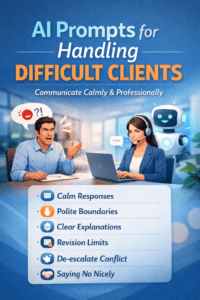
In this guide, you’ll learn how to use AI prompts to manage tough client conversations, protect your energy, and communicate like a seasoned professional.
What Are AI Prompts for Handling Difficult Clients?
AI prompts for handling difficult clients are carefully written instructions you give to an AI tool to generate calm, professional, and situation-aware responses. Instead of typing from frustration or stress, you guide the AI to craft messages that align with your goals.
These prompts don’t replace your judgment. They support it.
You May Like This :
- 25 Creative Prompts for Brand Naming & Slogans
- 15 best prompts for freelance project proposals
- 25 Easy Prompts for Content Calendar Planning That Save Time
- 20 Easy Prompts for Meeting Minutes & Summaries
- 20 Easy Prompts for Business Plan Generation
- 25 Creative Prompts for Abstract Digital Art
When you use them correctly, you:
- Reduce emotional reactions
- Maintain a professional tone under pressure
- Save time on rewriting and second-guessing
- Set boundaries without sounding rude
Calm Response to an Angry Client
Prompt:
“Rewrite this message in a calm, professional, and empathetic tone while clearly addressing the client’s concern: [paste client message]”

Use when: The client sounds angry or frustrated.
The result is communication that feels thoughtful, balanced, and confident no matter how challenging the client is.
Why Difficult Client Communication Is So Hard
Before using AI effectively, it helps to understand why these situations feel overwhelming.
Difficult clients often trigger:
- Fear of losing income
- Self-doubt about your skills
- Anger or defensiveness
- Pressure to respond immediately
Setting Boundaries Politely
Prompt:
“Write a polite but firm response explaining that this request is outside the agreed scope, while keeping the relationship positive.”

Use when: A client asks for extra work not included in the agreement.

When emotions are high, clarity drops. You may say too much, too little, or the wrong thing entirely. AI prompts act as a buffer between emotion and action, helping you respond strategically instead of emotionally.
Common Types of Difficult Clients You May Face
Not all difficult clients behave the same way. Identifying the type helps you choose better AI prompts.
Setting Boundaries Politely
Prompt:
“Write a polite but firm response explaining that this request is outside the agreed scope, while keeping the relationship positive.”

Use when: A client asks for extra work not included in the agreement.
The Angry Client
- Uses aggressive or accusatory language
- Focuses on problems, not solutions
The Unrealistic Client
- Expects instant results
- Requests work outside the agreed scope
De-escalating Emotional Messages
Prompt:
“Rewrite this response to sound neutral, empathetic, and solution-focused, avoiding emotional language.”

Use when: The conversation is getting personal or tense.
The Passive-Aggressive Client
- Gives vague feedback
- Expresses dissatisfaction indirectly
The Micromanager
- Requests constant updates
- Questions every decision
Each type requires a different tone, structure, and goal—exactly where tailored AI prompts shine.
How AI Prompts Help You Handle Difficult Clients Effectively
Clarifying Misunderstandings
Prompt:
“Create a clear and respectful message that explains my original agreement and corrects the misunderstanding without blaming the client.”
Use when: Expectations don’t match reality.
They Create Emotional Distance
AI doesn’t take messages personally. When you ask it to rewrite or respond, it removes emotional charge and focuses on clarity and professionalism.
Responding to Repeated Revisions
Prompt:
“Write a professional response that acknowledges the feedback and explains revision limits in a calm and collaborative way.”
Use when: Endless changes are draining your time.
They Improve Tone Without Weakening Your Position
AI prompts help you stay polite without sounding submissive, firm without sounding aggressive.
They Help You Say “No” the Right Way
Setting boundaries is difficult. AI prompts make it easier to refuse requests while preserving the relationship.
They Save Mental Energy
Instead of staring at a blank screen, you start with a strong draft and refine it.
The Anatomy of a High-Quality AI Prompt
Think of an AI prompt like a recipe. The better the ingredients, the better the result.
Prompt Ingredients Table
| Ingredient | Purpose | Example |
|---|---|---|
| Role | Defines authority | “Act as a senior client success manager” |
| Context | Explains the situation | “Client is unhappy with project delays” |
| Tone | Controls emotion | “Calm, empathetic, professional” |
| Goal | Defines outcome | “De-escalate and propose next steps” |
When all four are present, the AI delivers responses that sound human, thoughtful, and intentional.
Best AI Prompts for Handling Difficult Clients
Below are practical examples you can adapt immediately.
AI Prompt for an Angry Client
- “Act as an experienced account manager. Write a calm, empathetic response acknowledging the client’s frustration, taking responsibility where appropriate, and proposing a clear solution without sounding defensive.”
AI Prompt for Unrealistic Expectations
- “Respond professionally to a client requesting work outside the original agreement. Maintain a respectful tone, clarify boundaries, and suggest alternative options.”
AI Prompt for Passive-Aggressive Feedback
- “Rewrite this message to sound polite, direct, and solution-focused while addressing unclear feedback and requesting specific clarification.”
AI Prompt for Late Payments
- “Write a firm but courteous payment reminder that preserves the relationship and references agreed terms without sounding threatening.”
These AI prompts for handling difficult clients allow you to stay in control of the conversation while protecting your professionalism.
Mistakes to Avoid When Using AI Prompts
AI is powerful—but only when used wisely.
Don’t Send Raw AI Output Without Reviewing
Always read and adjust the response to match your voice.
Don’t Ignore Emotional Context
A calm client and an angry client need different tones, even if the issue is similar.
Don’t Over-Explain
AI sometimes adds unnecessary detail. Short, clear messages often work best.
Who Benefits Most from AI Prompts for Handling Difficult Clients?
These prompts are especially useful if you are:
- A freelancer dealing with demanding clients
- A consultant managing long-term relationships
- A customer support professional handling complaints
- A business owner balancing growth and client satisfaction
If client communication affects your income or reputation, AI prompts are a strategic tool—not a shortcut.
Frequently Asked Questions About AI Prompts for Handling Difficult Clients
What are AI prompts for handling difficult clients?
They are structured instructions that guide AI to generate professional, calm, and goal-oriented responses in challenging client situations.
Can AI prompts really improve client relationships?
Yes. Clear, empathetic communication reduces misunderstandings and defuses tension before it escalates.
Are AI-generated responses safe to send to clients?
They are safe when reviewed and customized. AI provides structure; you provide judgment.
Do AI prompts work for angry clients?
They are especially effective for de-escalation, helping you acknowledge emotions without admitting unnecessary fault.
Can beginners use AI prompts for handling difficult clients?
Absolutely. They are often more helpful for beginners who haven’t yet developed confidence in client communication.
Turn Difficult Conversations Into Professional Wins
Difficult clients are part of business—but stress, burnout, and emotional reactions don’t have to be. When you use AI prompts for handling difficult clients, you give yourself space to think clearly, respond strategically, and protect both your time and reputation.
Instead of reacting, you respond.
Instead of guessing, you communicate with purpose.
Instead of dreading client messages, you handle them with confidence.
Call to Action
Start building your own library of AI prompts for handling difficult clients today. Test them, refine them, and make calm, professional communication your competitive advantage.
Frequently Asked Questions (FAQ)
What are AI Prompts for Handling Difficult Clients?
AI Prompts for Handling Difficult Clients are carefully written instructions you give to an AI tool to help you respond professionally to challenging client situations. They help you stay calm, clear, and respectful while protecting your boundaries.
Who should use AI Prompts for Handling Difficult Clients?
These prompts are useful for freelancers, customer support agents, consultants, coaches, agency owners, and anyone who communicates with clients regularly and wants to reduce stress and misunderstandings.
Can AI prompts really help with angry or emotional clients?
Yes. AI prompts are especially effective in emotional situations because AI responds logically and neutrally. This helps de-escalate conflict, avoid emotional reactions, and keep the conversation solution-focused.
Are AI Prompts for Handling Difficult Clients professional enough for business emails?
Absolutely. When written correctly, AI prompts can produce polite, clear, and business-appropriate messages suitable for emails, live chat, CRM tools, and support tickets.
Will using AI make my responses sound robotic?
Not if you guide it properly. By adding context, tone preferences, and examples, AI can generate responses that sound natural, human, and aligned with your personal or brand voice.
Can AI prompts help set boundaries without losing clients?
Yes. AI prompts are excellent for setting boundaries politely. They help explain limits, scope, and expectations clearly while keeping the relationship respectful and professional.
Is it ethical to use AI for client communication?
Yes. AI is simply a communication assistant, like spell-check or grammar tools. As long as you review and approve messages before sending, using AI is both ethical and professional.