prompt for brand illustration style guide images
Prompt for Brand Illustration Style Guide Images: Create Consistent, High-Impact Visuals for Your Brand
Introduction: Why Your Brand Visuals Deserve More Than Random Images
You don’t just see a brand—you feel it. Before someone reads your tagline or explores your product, they’re already forming an impression based on your visuals. That first impression often comes from your illustrations: the colors, the shapes, the characters, and the mood they create.
If your visuals feel scattered, your brand feels unreliable. But when everything aligns—when every image looks like it belongs together—you build trust without saying a word. That’s exactly why mastering a prompt for brand illustration style guide images is no longer optional. It’s your shortcut to consistency, clarity, and a stronger identity.
This guide shows you how to craft powerful prompts that generate cohesive illustrations, strengthen your branding, and elevate your entire visual presence.
What Is a Prompt for Brand Illustration Style Guide Images?
A prompt for brand illustration style guide images is a structured instruction you give to AI tools or designers to create visuals that match your brand identity. Instead of generating random images, you guide the output with clear rules and visual direction.
When you use prompts effectively, you:
- Maintain a consistent look across all platforms
- Save time on revisions
- Ensure every image reflects your brand personality
Think of it as your visual blueprint. Without it, every design decision becomes guesswork. With it, your brand speaks with one clear voice.
Why Consistency in Brand Illustrations Matters
You’ve probably noticed how some brands feel instantly recognizable. That’s not luck—it’s consistency.
When your illustrations follow a unified style:
- Your audience remembers you faster
- Your content looks more professional
- Your marketing feels more cohesive
Inconsistent visuals, on the other hand, create confusion. If one image is playful and another is overly corporate, your audience struggles to understand who you are.
Consistency builds familiarity. Familiarity builds trust. And trust drives engagement.
Key Elements of a Strong Illustration Style Guide Prompt
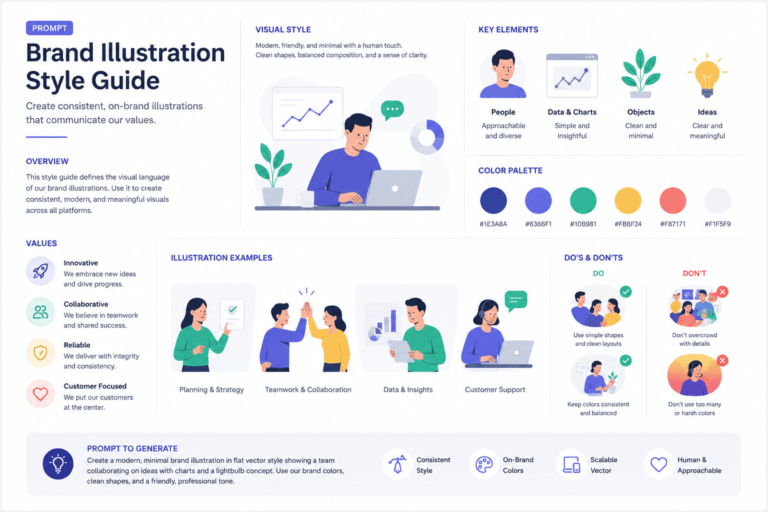
To create effective prompts, you need to define the building blocks of your visual identity. Each element plays a role in shaping how your brand is perceived.
Visual Style
Start by choosing a clear illustration style. This sets the foundation for everything else.
Examples include:
- Flat design for modern simplicity
- 3D illustrations for depth and realism
- Cartoon or anime style for playful brands
- Minimalist line art for clean, elegant visuals
Be specific. Instead of saying “nice design,” say “clean flat illustration with soft edges and minimal shading.”
Color Palette
Your colors should remain consistent across all visuals.
Define:
- Primary colors (your main brand tones)
- Secondary colors (supporting shades)
- Accent colors (for highlights and contrast)
Use clear descriptors like:
- “Soft pastel tones”
- “Bold, high-contrast neon palette”
- “Muted earth tones with warm undertones”
Characters and Objects
If your brand uses characters or icons, describe them in detail.
Include:
- Style (cartoon, realistic, stylized)
- Proportions (exaggerated, balanced)
- Expressions (friendly, serious, energetic)
This ensures every generated image feels like part of the same universe.
Composition and Layout
Structure matters more than you think. Define how elements should be arranged.
For example:
- Centered composition for focus
- Grid-based layout for clarity
- Balanced spacing with clean margins
This helps maintain visual harmony across all images.
Lighting and Mood
Lighting shapes emotion. A small change can completely shift the tone of your visuals.
Specify:
- Soft lighting for a calm feel
- Bright lighting for energy
- Dramatic shadows for depth
How to Write High-Quality Prompts That Actually Work
Creating a strong prompt for brand illustration style guide images isn’t about writing more—it’s about writing smarter.
Follow this simple process:
Step 1: Define Your Brand Identity
Ask yourself:
- Is your brand playful or professional?
- Minimal or detailed?
- Bold or subtle?
Your answers guide your entire prompt.
Step 2: Use Clear, Descriptive Language
Avoid vague terms like “cool” or “nice.” Replace them with specific descriptors.
Instead of:
- “Make it modern”
Say:
- “Modern flat illustration with clean lines and soft gradients”
Step 3: Structure Your Prompt
A good prompt usually follows this pattern:
- Style
- Colors
- Subject
- Composition
- Mood
Example:
“Flat illustration style, soft pastel color palette, friendly cartoon character, centered composition, minimal background, clean and modern look.”
Step 4: Keep It Consistent
Once you find a prompt that works, reuse it. Small variations are fine, but the core structure should stay the same.
Common Mistakes You Should Avoid
Even strong brands make mistakes when creating illustration prompts. Avoid these pitfalls to keep your visuals sharp.
Overloading the Prompt
Too many instructions can confuse the output. Keep your prompt focused and clear.
Ignoring Brand Identity
If your visuals don’t match your brand personality, they won’t connect with your audience.
Changing Style Too Often
Switching styles frequently weakens your brand recognition. Stick to one consistent direction.
Practical Use Cases for Brand Illustration Style Guide Images
Once you’ve created your prompt, you can use it across multiple touchpoints.
Marketing Campaigns
- Social media posts
- Ads and banners
- Email graphics
Product Design
- App onboarding screens
- UI illustrations
- Feature highlights
Website Design
- Hero sections
- Landing pages
- Blog visuals
Using the same prompt across these areas ensures your brand looks unified everywhere.
Example Prompt Ingredients Table
Think of your prompt like a recipe. Each ingredient adds something important to the final result.
| Element | Example Description | Purpose |
|---|---|---|
| Style | Flat, minimalist illustration | Defines overall look |
| Colors | Soft blue and white palette | Sets mood and identity |
| Characters | Friendly cartoon figures | Adds personality |
| Composition | Centered layout with clean spacing | Ensures balance |
| Lighting | Soft and even lighting | Enhances clarity |
| Background | Minimal or gradient | Keeps focus on subject |
Tools You Can Use to Generate Brand Illustrations
You don’t need to be a professional designer to create high-quality visuals anymore. With the right tools, your prompts can do most of the work.
Popular options include:
- AI image generators for fast creation
- Design platforms for refinement
- Vector tools for scalability
Choose tools that allow you to reuse prompts and maintain consistency.
How to Maintain Long-Term Visual Consistency
Creating a great prompt is just the beginning. The real value comes from using it consistently.
Here’s how you keep everything aligned:
- Build a prompt library you can reuse
- Document your style guide clearly
- Use reference images to guide future designs
- Review visuals regularly to ensure consistency
Over time, your brand will develop a recognizable visual signature.
Conclusion: Turn Your Prompts Into a Powerful Branding System
A well-crafted prompt for brand illustration style guide images does more than generate visuals—it shapes how your audience experiences your brand.
When your illustrations feel consistent, your brand feels reliable. When your visuals align, your message becomes stronger. And when everything works together, your audience starts to recognize you instantly.
Start by defining your style, refining your prompts, and staying consistent. You don’t need perfection—you need clarity and direction.
Call to Action
Now it’s your turn. Take a few minutes to write your own prompt for brand illustration style guide images using the structure you’ve learned here. Test it, refine it, and build your visual identity step by step.
If you want faster results, start building a small library of prompts today and use them across your app, website, and marketing materials. The sooner you begin, the sooner your brand will stand out.