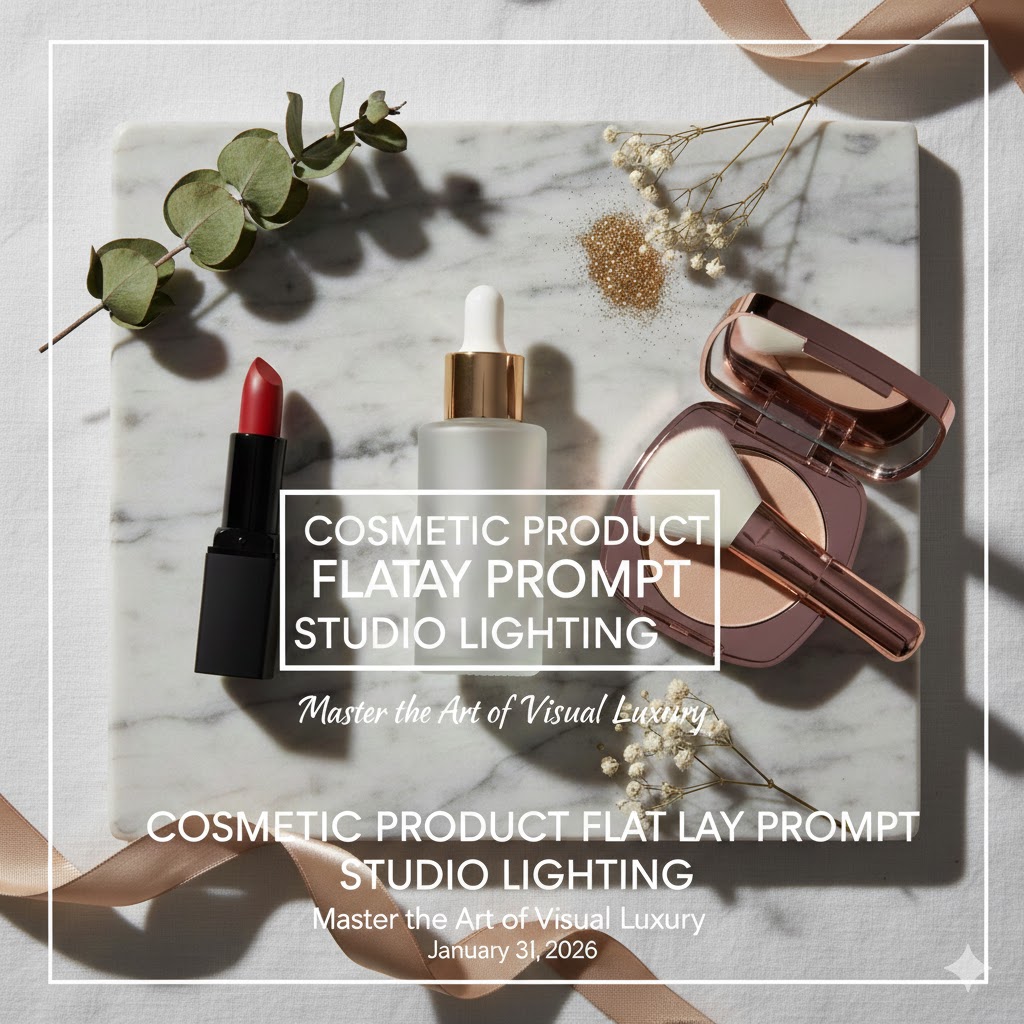
Cosmetic Product Flat Lay Prompt Studio Lighting: The Pro Guide
Master the Art of Visual Luxury: The Ultimate Guide to Cosmetic Product Flat Lay Prompt Studio Lighting
You know that feeling when you’re scrolling through a high-end beauty feed and a single image stops you dead in your tracks? It’s usually a crisp, perfectly balanced shot of a serum bottle resting on textured stone, bathed in a glow that looks both expensive and effortless. You’ve likely tried to recreate it—maybe you’ve cleared off your desk, grabbed your phone, and spent an hour moving a desk lamp around, only to end up with harsh glares and muddy shadows.
It’s frustrating when your creative vision doesn’t match your output. But here is the secret: the “magic” isn’t in the camera; it’s in the light. Whether you are a photographer, a brand owner, or a digital artist using generative AI, mastering cosmetic product flat lay prompt studio lighting is your ticket to a professional aesthetic. Let’s pull back the curtain on how to build these visuals from the ground up.
Why Lighting is the “Silent Salesman” of Cosmetics
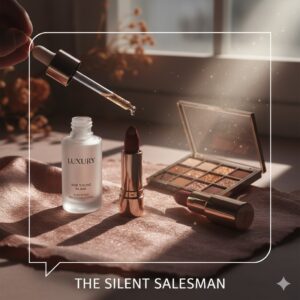
In the beauty industry, your product isn’t just a liquid in a bottle; it’s a promise of luxury, health, or transformation. Lighting communicates that promise instantly. If your lighting is flat, your brand feels cheap. If it’s overly harsh, it feels clinical.
When you use the right cosmetic product flat lay prompt studio lighting techniques, you aren’t just showing a product; you are creating an atmosphere. Soft, diffused light suggests hydration and gentleness—perfect for skincare. High-contrast, directional light suggests bold pigments and power—perfect for evening makeup.
2. Setting the Stage: The Anatomy of a Professional Flat Lay
Before we talk about the lights, you need to understand the “flat lay” itself. This 90-degree, bird’s-eye view is the gold standard for e-commerce and social media because it allows you to tell a story through curated “clutter.”
Key Elements of Composition:
The Hero Product: Your main focus. It should be the brightest or most centered element.
Supporting Props: Think dried botanicals, silk ribbons, or raw ingredients like coffee beans or rose petals.
Negative Space: Don’t crowd the frame. Let the “air” in the photo direct the viewer’s eye to the product.
3. The Technical Recipe: Cosmetic Product Flat Lay Prompt Studio Lighting
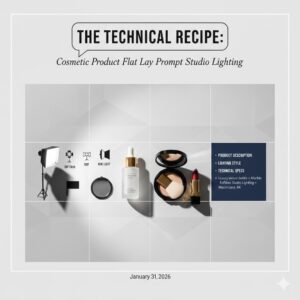
If you are working with AI tools or setting up a physical shoot, you need a specific “ingredient list” to achieve professional results. Here is a breakdown of the elements that create that elusive “studio” look.
Essential “Ingredients” for Your Visual Prompt
| Component | Keyword/Technique | Resulting Effect |
| Primary Light | Softbox or Octabox | Even, wrap-around light with soft shadows. |
| Fill Light | Reflector or Low-power LED | Fills in dark areas to keep the product visible. |
| Accent Light | Rim lighting / Backlighting | Creates a halo effect, separating the bottle from the background. |
| Texture Detail | Macro Focus / 8k Resolution | Shows the fine details of the packaging and product “swatches.” |
4. Crafting the “Perfect Prompt” for AI Generation
If you’re using AI to generate your brand’s mood boards or social assets, your words act as your lighting technician. You can’t just say “makeup on a table.” You need to be specific.
H3: The Formula for Success
When writing a cosmetic product flat lay prompt studio lighting sequence, follow this structure:
[Product Description] + [Surface Texture] + [Specific Lighting Style] + [Camera Technicals]
Example Prompt:
“A luxury gold-capped facial oil glass bottle, flat lay composition on a white ribbed plaster surface, surrounded by soft eucalyptus leaves. Professional studio lighting with softbox diffusion, subtle caustic reflections through the glass, soft-focus background, 8k resolution, photorealistic.”
H3: Keywords That Change the Game
To bypass that “flat AI look,” try incorporating these specific lighting descriptors:
Volumetric Lighting: Adds a sense of depth and “air” to the shot.
Chiaroscuro: For a moody, high-contrast look that feels dramatic.
Golden Hour Diffusion: Mimics the warmth of a sunset through a window.
Top-Down Softbox: Ensures there are no distracting glares on shiny lids.
5. Lighting for Different Textures: A Cheat Sheet
Different materials react to light in unique ways. You wouldn’t light a matte lipstick the same way you’d light a glass perfume bottle.
H4: Dealing with Reflective Glass
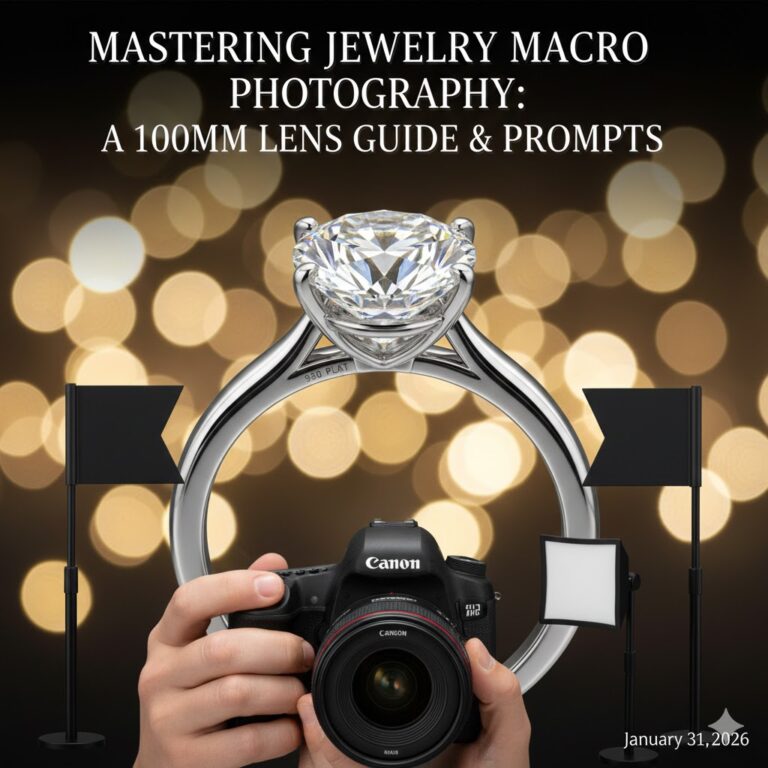
Glass is a nightmare for beginners because it reflects everything in the room. In your cosmetic product flat lay prompt studio lighting setup, you want to use “Gobo” (Go Between) techniques. These are shields that block light from hitting specific spots, creating those clean, vertical white lines you see on expensive perfume ads.
H4: Accentuating Matte Textures
For matte packaging—think NARS or Fenty style—you need side lighting. By placing your light at a low angle from the side, you emphasize the “velvet” feel of the packaging. If the light is directly overhead, the matte texture will just look like flat plastic.
6. Creating “Mood” Through Color Temperature

Lighting isn’t just about brightness; it’s about color.
Cool Lighting (5000K-6000K): Feels clinical, clean, and modern. Great for “Doctor-led” skincare or medical beauty.
Warm Lighting (2700K-3500K): Feels cozy, organic, and inviting. Perfect for “Clean Beauty” or evening routine products.
Neutral Lighting: The “true-to-life” standard for makeup where color accuracy is everything.
7. Common Pitfalls to Avoid
Even with the best cosmetic product flat lay prompt studio lighting, things can go wrong. Watch out for these:
The “Floating” Product: If you have zero shadows, the product looks like it was poorly Photoshopped onto the background. Always ensure there is a “contact shadow.”
Over-Saturation: Too much light can “blow out” the colors, making a soft pink look like a harsh white.
Distracting Backgrounds: Your background should never be busier than your product. When in doubt, go for marble, linen, or matte paper.
8. FAQ: Your Cosmetic Lighting Questions Answered
How do I get that “glowing” look in my cosmetic product flat lay prompt studio lighting?
The “glow” usually comes from backlighting. By placing a small, controlled light source behind or slightly underneath a translucent product (like a gel or oil), the liquid catches the light and appears to be illuminated from within.
What is the best background for a cosmetic flat lay?
Neutral, non-reflective surfaces are best. Think unpolished stone, matte ceramic tiles, or high-quality linen. Avoid shiny plastic, as it creates “hot spots” that distract from the product.
Can I achieve professional lighting without expensive gear?
Yes! If you are shooting physically, use a large window for natural light and a white foam board to bounce that light back onto the dark side of your product. If you are using AI, simply include keywords like “natural window light with sheer curtain diffusion” in your prompt.
Why does my AI-generated text look weird on the bottles?
AI still struggles with specific text. Focus your cosmetic product flat lay prompt studio lighting on the aesthetic and vibe, then use a tool like Canva or Photoshop to overlay your actual brand logo and labels for a professional finish.
Conclusion: Lighting is Your Creative Superpower
Creating stunning imagery doesn’t require a Hollywood budget; it requires an eye for detail and the right vocabulary. By mastering cosmetic product flat lay prompt studio lighting, you’re giving your brand the visual authority it deserves. You’re moving away from “just a photo” and toward a cohesive, luxurious brand identity that resonates with your audience.
Remember, the best lighting doesn’t just show the product—it makes the viewer want to reach out and touch it.
Ready to transform your brand’s visual identity? I can help you build a custom “Prompt Style Guide” tailored to your specific product line. Would you like me to generate a set of 10 unique, high-conversion prompts for your upcoming product launch?