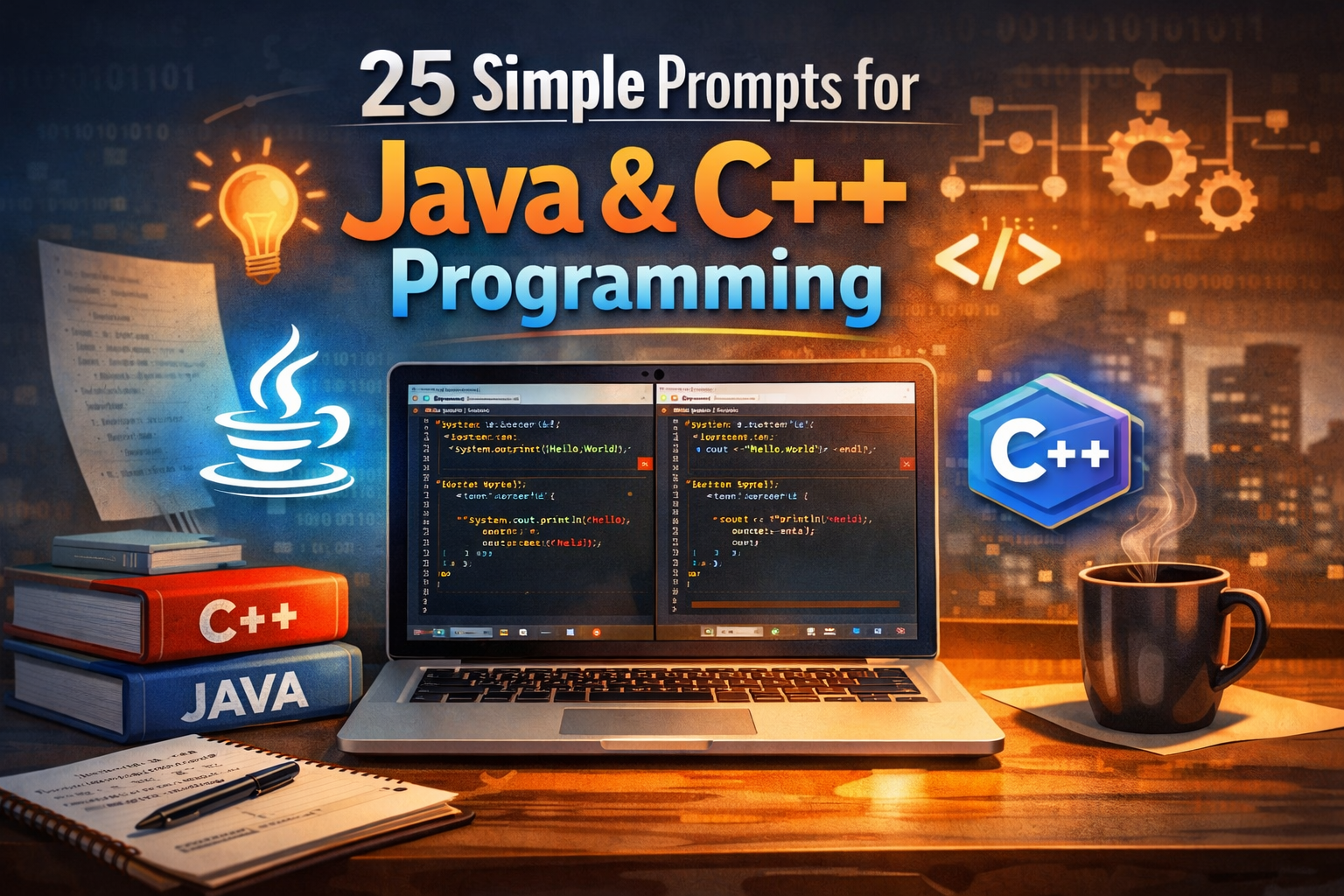
25 Simple Prompts for Java & C++ Programming That Build Real Skills Step by Step
25 Simple Prompts for Java & C++ Programming That Build Real Skills Step by Step
Starting with Java or C++ often feels harder than it should. You learn syntax, watch tutorials, maybe even understand the theory—but when it’s time to code something on your own, your mind goes blank. That moment is frustrating, and if it happens too often, motivation drops fast.
This is where 25 simple prompts for Java & C++ programming make a real difference. Instead of guessing what to build, you get clear, focused challenges that guide your thinking and push you forward without overwhelming you. You don’t need advanced concepts or huge projects. You need practice that makes sense.
In this article, you’ll discover how simple programming prompts help you learn faster, how to use them correctly, and how each group of prompts strengthens a specific skill you actually need as a programmer.
Why Simple Programming Prompts Are So Effective
When you’re learning to code, the biggest obstacle is not complexity—it’s uncertainty. Prompts remove that uncertainty by giving you a clear task and a defined goal.
Here’s why simple prompts work so well for Java and C++ learners:
- You focus on problem-solving, not guessing what to code
- You practice reading errors and fixing them
- You gain confidence through small, repeatable wins
- You build logic that transfers to real projects
Instead of passively watching tutorials, you actively engage with the language. That shift alone can dramatically improve how quickly you learn.
 Who Should Use These 25 Simple Prompts for Java & C++ Programming?
 Who Should Use These 25 Simple Prompts for Java & C++ Programming?
These prompts are designed for you if:
- You are a beginner learning Java or C++
- You understand basics but struggle to apply them
- You want daily practice without burnout
- You are learning both languages and want to compare logic
Each prompt is intentionally simple and language-neutral. You can solve the same problem in Java and then in C++, which helps you understand how programming works, not just how syntax looks.
How to Use Programming Prompts the Right Way
Before jumping into the prompts, it helps to follow a simple process:
- Read the prompt carefully
- Write your own solution from scratch
- Run the code and observe errors
- Improve clarity or efficiency
- Try solving the same prompt in the other language
Avoid copying solutions immediately. Struggling a little is part of learning. Every error you fix strengthens your understanding.
25 Simple Prompts for Java & C++ Programming
The prompts below are grouped by skill level and concept so you can progress naturally.
Basic Syntax and Output Prompts (1–5)
 Basic Syntax and Output Prompts (1–5)
These prompts help you get comfortable with the structure of a program.
- Print a message to the console
- Declare variables of different data types
- Perform basic arithmetic operations
- Read user input and display it
- Swap two numbers
What you practice here:
Variables, data types, input/output, and program flow. These are the building blocks you’ll use in every program you write.
Conditional Logic Prompts (6–10)
Once you understand basic structure, you need to make decisions in code.
- Check if a number is even or odd
- Compare two numbers and display the larger one
- Determine whether a year is a leap year
- Assign grades based on a score
- Check whether a character is a vowel or a consonant
What you practice here:
If-else statements, logical operators, and decision-making. This is where your code starts to “think.”
Looping and Repetition Prompts (11–15)
Loops allow you to automate repetitive tasks, which is essential in real programs.
- Print numbers from 1 to 100
- Calculate the sum of the first N numbers
- Generate a multiplication table
- Reverse a number using a loop
- Count the digits in a number
What you practice here:
For loops, while loops, iteration, and understanding how conditions control repetition.
Functions and Methods Prompts (16–20)
Now you move toward writing cleaner, reusable code.
- Create a function that adds two numbers
- Find the maximum of three values
- Convert Celsius to Fahrenheit
- Check whether a number is prime
- Calculate factorial using a function
What you practice here:
Functions in C++, methods in Java, parameters, return values, and code organization.
Arrays and Strings Prompts (21–25)
These prompts introduce working with collections of data and text.
- Store numbers in an array and display them
- Find the largest value in an array
- Reverse a string
- Count vowels in a string
- Check whether a string is a palindrome
What you practice here:
Arrays, strings, indexing, loops with data structures, and basic data manipulation.
Java vs C++: What Changes When Solving the Same Prompt?
Solving identical prompts in Java and C++ helps you understand the real differences between the languages without confusion.
| Concept | Java | C++ |
|---|---|---|
| Input | Scanner | cin |
| Output | System.out.println | cout |
| Memory handling | Automatic | Manual (optional) |
| Strings | String class | string / char arrays |
By practicing the same logic in both languages, you learn transferable skills instead of memorizing syntax.
How These Simple Prompts Improve Real Programming Skills
You might wonder if small prompts really matter. They do—because every large application is built from these same ideas.
By practicing these 25 simple prompts for Java & C++ programming, you develop:
- Logical thinking
- Debugging confidence
- Cleaner code habits
- The ability to start projects without fear
Once these fundamentals feel natural, moving to larger projects becomes far less intimidating.
Frequently Asked Questions About Java & C++ Programming Prompts
Are these 25 simple prompts for Java & C++ programming suitable for beginners?
Yes. They are intentionally designed to be approachable while still teaching core concepts.
Should you learn Java or C++ first?
That depends on your goals. Java is often easier for beginners, while C++ offers deeper control. These prompts work well for both.
How often should you practice programming prompts?
Consistency matters more than volume. One prompt per day is enough to see steady improvement.
Can these prompts help with exams or coding interviews?
Absolutely. They reinforce fundamentals that are commonly tested.
Conclusion: Small Prompts, Big Progress
You don’t need complex frameworks or massive projects to become better at programming. What you need is focused, meaningful practice. These 25 simple prompts for Java & C++ programming give you a clear path forward—one problem at a time.
Start with a single prompt today. Solve it carefully. Then solve it again tomorrow in the other language. That habit, repeated consistently, is what turns beginners into confident programmers.