
The Ultimate Guide to Nano Banana Prompt Engineering for Beginners (2026)
Nano banana prompt engineering is one of the most practical skills you can learn if you want clearer, more predictable outputs from modern generative systems. If you are a beginner, this guide will walk you through what nano banana prompt engineering is, why it matters, and how to apply it step by step—without jargon, hype, or shortcuts.
This article is written for people who want hands-on results, not theory. You will learn how to structure prompts, avoid common mistakes, and build prompts that actually work in real use cases.
What Is Nano Banana Prompt Engineering?
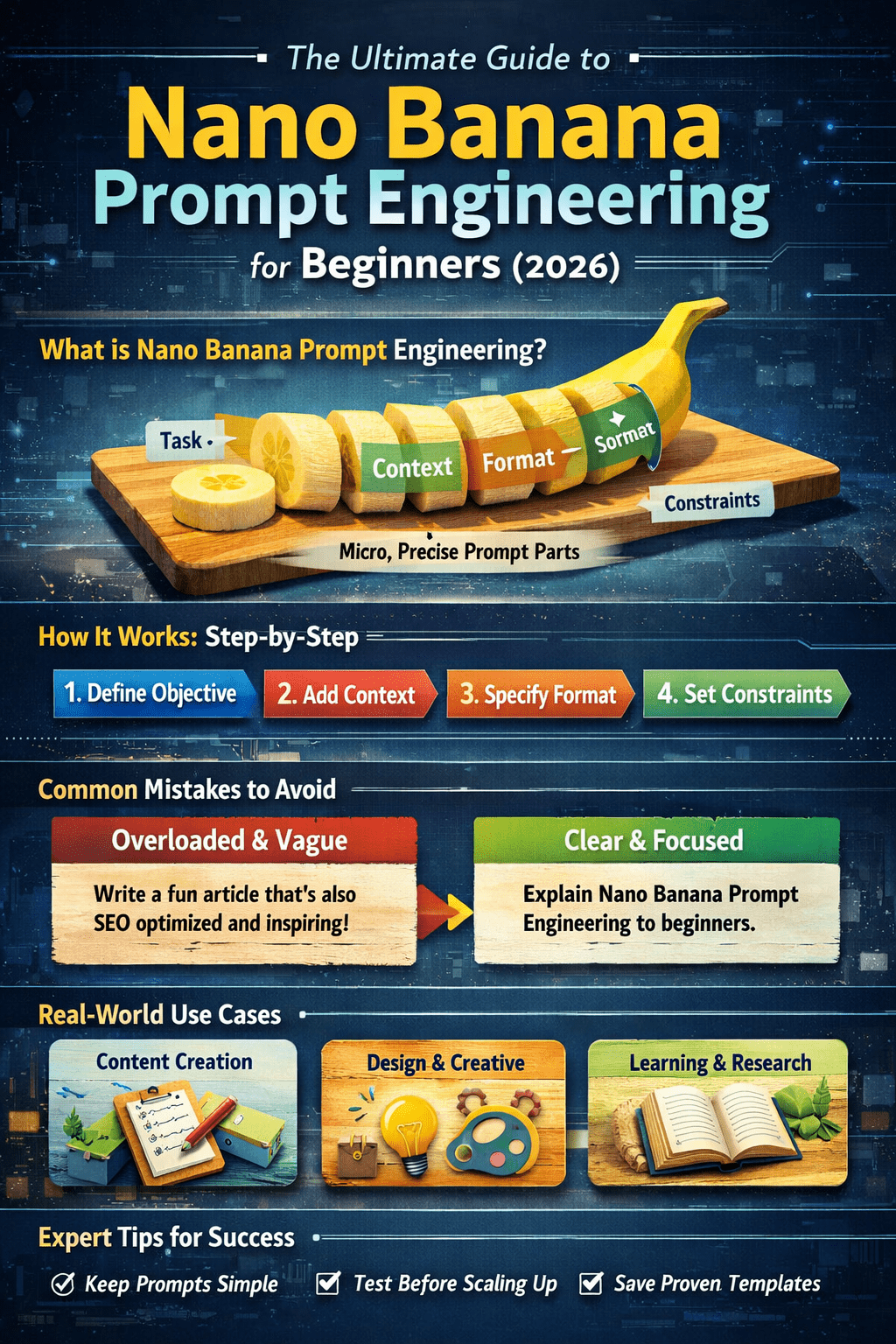
Nano banana prompt engineering is a micro-structured approach to writing prompts. Instead of long, vague instructions, you break your prompt into small, precise components—each one handling a single task or constraint.
Think of it like slicing a banana into thin pieces instead of throwing it in whole. Each slice has a clear purpose.
Key Characteristics
- Short, focused prompt segments
- Clear intent per instruction
- Minimal ambiguity
- Strong control over output format and tone
This method is especially effective for beginners because it reduces confusion and trial-and-error.
Why Nano Banana Prompt Engineering Matters in 2026
As generative systems become more capable, prompt quality matters more than ever. Poorly structured prompts waste time and produce inconsistent results.
Nano banana prompt engineering helps you:
- Get repeatable results
- Reduce corrections and retries
- Maintain consistent style and output
- Scale your workflows efficiently
For new creators, bloggers, designers, and developers, this approach gives you control without complexity.
How Nano Banana Prompt Engineering Works (Simple Breakdown)
Step 1: Define One Clear Objective
Never start with “do everything.”
Start with one outcome.
Bad example:
Create an article, summarize it, optimize SEO, and make it funny.


Good example:
Write a beginner-friendly explanation of nano banana prompt engineering.

One goal per prompt is the foundation.
Step 2: Add Context (Only What’s Necessary)
Context tells the system how to think, not what to invent.
Good context examples:
- Target audience
- Skill level
- Output purpose
Avoid:
- Personal backstories
- Emotional filler
- Contradictory instructions

Step 3: Specify the Output Format
This is where nano banana prompt engineering shines.
Examples:
- Bullet points
- Step-by-step list
- Table
- Short paragraphs
If you don’t specify format, expect randomness.

Step 4: Apply Constraints
Constraints act like guardrails.
Common constraints:
- Word count range
- Tone (neutral, educational)
- Point of view
- Language style
Nano banana prompts limit freedom intentionally—that’s why they work.
Beginner-Friendly Nano Banana Prompt Template
Use this template to get started:
Task: [Single clear action]
Audience: [Who it’s for]
Context: [Only essential background]
Format: [Exact structure]
Constraints: [Length, tone, rules]
This structure alone will dramatically improve your results.
Common Beginner Mistakes (And How to Fix Them)
1. Overloading the Prompt
Too many instructions = diluted output.
Fix: Split tasks into multiple prompts.
2. Using Vague Language
Words like “nice,” “good,” or “better” have no technical meaning.
Fix: Replace vague words with measurable criteria.
3. Ignoring Output Structure
Unstructured prompts lead to inconsistent formatting.
Fix: Always define layout.
4. Changing Goals Mid-Prompt
Conflicting instructions confuse the system.
Fix: One goal per prompt. Always.
Best Practices for Nano Banana Prompt Engineering
- Start small, then iterate
- Reuse proven prompt structures
- Document what works
- Test prompts in isolation
- Keep instructions human and direct
Consistency beats creativity at the beginner stage.
Real-World Use Cases
Content Creation
- Article outlines
- Section rewriting
- Headline variations
Design & Creative Work
- Image descriptions
- Style constraints
- Scene breakdowns
Learning & Research
- Concept explanations
- Step-by-step guides
- Simplified summaries
Nano banana prompt engineering adapts easily across industries.
Expert Tips From Real-World Practice
- Write prompts like you’re briefing a junior teammate
- Remove every word that doesn’t change the outcome
- Save your best prompts as templates
- Test prompts on simple tasks before complex ones
- When results are bad, shorten—not expand—the prompt
Small prompts reveal problems faster.
Visual Examples (Recommended Images)
Image 1
Placement: After “What Is Nano Banana Prompt Engineering?”
Prompt: Minimalist diagram showing a banana sliced into labeled sections representing prompt components
File name: nano-banana-prompt-structure.png
ALT text: Diagram explaining nano banana prompt engineering structure
Image 2
Placement: After “How Nano Banana Prompt Engineering Works”
Prompt: Clean flowchart showing step-by-step prompt breakdown
File name: nano-banana-prompt-steps.png
ALT text: Step-by-step nano banana prompt engineering process
Image 3
Placement: After “Common Beginner Mistakes”
Prompt: Split-screen illustration showing bad vs good prompt examples
File name: nano-banana-prompt-mistakes.png
ALT text: Common mistakes in nano banana prompt engineering
Image 4
Placement: After “Real-World Use Cases”
Prompt: Workspace scene with notes and structured prompt blocks
File name: nano-banana-prompt-use-cases.png
ALT text: Practical applications of nano banana prompt engineering
Internal Linking Opportunities (Topical Authority)
- Anchor: “prompt structure basics”
Article type: Beginner prompt fundamentals guide - Anchor: “advanced prompt constraints”
Article type: Intermediate tutorial - Anchor: “writing clearer instructions”
Article type: Communication skills article - Anchor: “prompt testing frameworks”
Article type: Experimentation guide - Anchor: “prompt optimization checklist”
Article type: Practical checklist post
External Authority Sources (Suggested)
- Anchor: “prompt engineering overview” → Educational reference
- Anchor: “instruction clarity principles” → Research or academic source
- Anchor: “human-computer interaction basics” → Industry blog
- Anchor: “structured writing methods” → Writing authority site
FAQ (Optimized for Featured Snippets)
What is nano banana prompt engineering?
It’s a method of breaking prompts into small, precise components to improve clarity and results.
Is nano banana prompt engineering good for beginners?
Yes. It reduces complexity and makes prompt behavior easier to predict.
How long should a nano banana prompt be?
As short as possible while still being clear—usually a few lines.
Can I reuse nano banana prompts?
Absolutely. Reusable templates are one of its biggest strengths.
Does nano banana prompt engineering work for all tasks?
It works best for structured tasks but can be adapted for creative work too.
Conclusion: Start Small, Stay Precise
Nano banana prompt engineering is not about clever wording—it’s about clear thinking. As a beginner, this approach helps you build confidence, avoid frustration, and get consistent outcomes.
Start with small prompts. Refine them. Save what works.
If you apply the principles in this guide, you will already be ahead of most beginners in 2026.
Next step: Create your first nano banana prompt today—and keep it simple.