
How to Use ChatGPT for Efficient Market Research to Make Smarter Decisions
How to Use ChatGPT for Efficient Market Research (A Practical Guide You Can Apply Today)
Market research used to be slow, expensive, and exhausting. You gathered surveys, waited weeks for responses, hired consultants, and still felt unsure about your conclusions. Today, you have a different option. When used correctly, ChatGPT can help you speed up market research, clarify insights, and make smarter decisions—without drowning in data.
This guide shows you how to use ChatGPT for efficient market research, step by step. You’ll learn how to turn vague questions into structured insights, avoid common mistakes, and use AI as a thinking partner instead of a shortcut. Everything here is written for you, the decision-maker, not a data scientist.
 Why Market Research Still Matters (Even with AI)
 Why Market Research Still Matters (Even with AI)
Before using any tool, you need to understand why market research matters.
Market research helps you:
- Understand what your audience actually wants
- Reduce risk before launching a product or campaign
- Identify gaps your competitors ignore
- Make decisions based on insight, not assumptions
ChatGPT doesn’t replace this process. It accelerates and sharpens it.
What Makes ChatGPT Useful for Market Research
ChatGPT works well for market research because it excels at language-based reasoning. It can summarize patterns, simulate perspectives, and organize messy information into clear frameworks.
When you use it correctly, ChatGPT helps you:
- Explore customer pain points quickly
- Generate buyer personas and use cases
- Analyze competitors from public data
- Brainstorm trends and opportunities
- Test assumptions before investing money
The key is how you ask questions.
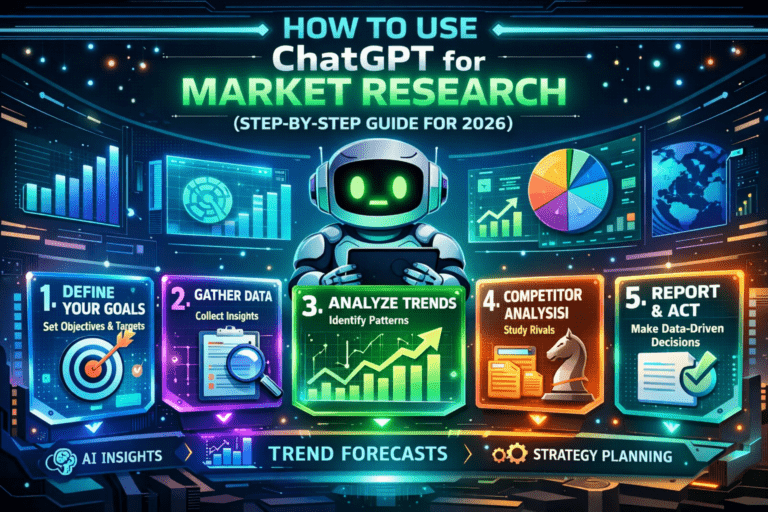
Step 1: Define Clear Market Research Goals
Efficient research starts with clarity. If you don’t know what you’re trying to learn, ChatGPT will give you generic answers.
Before writing any prompt, ask yourself:
- Are you researching a market, a product idea, or an audience?
- Do you want insight, validation, or ideas?
- What decision will this research support?
Example goal-focused prompt
- “You are a market research analyst. Help me understand the main problems faced by small online business owners when managing customer feedback.”
Clear goals = useful output.
Step 2: Use ChatGPT to Understand Your Target Audience
 Step 2: Use ChatGPT to Understand Your Target Audience
One of the fastest wins is audience research. ChatGPT can help you organize what your customers think, feel, and struggle with.
You can explore:
- Demographics and context
- Emotional drivers
- Daily frustrations
- Buying motivations
Sample prompts
- “Describe the typical frustrations of freelance designers when choosing productivity tools.”
- “What emotional triggers influence purchasing decisions in this market?”
Use the responses to:
- Refine messaging
- Improve positioning
- Write more relevant content
Step 3: Build Buyer Personas with AI Support
Buyer personas help you visualize your audience. ChatGPT can draft realistic personas that you can later refine with real data.
Ask ChatGPT to include:
- Age range and role
- Goals and fears
- Common objections
- Decision-making behavior
Persona prompt example
- “Create a detailed buyer persona for a startup founder researching market validation tools.”
This gives you a starting structure, not a final truth.
Step 4: Analyze Competitors Faster and Smarter
Competitor analysis often takes hours of browsing websites and reviews. ChatGPT can shorten that process by helping you structure your analysis.
You can use it to:
- Compare strengths and weaknesses
- Identify recurring complaints
- Spot missing features
- Understand positioning language
Useful competitor prompt
- “Based on public information, compare common weaknesses of existing solutions in this market.”
Pair ChatGPT’s insights with:
- Website reviews
- Pricing pages
- Customer testimonials
This combination improves accuracy.
Step 5: Discover Market Trends and Opportunities
Trend research is where ChatGPT really shines. It helps you explore what might be coming next, not just what exists now.
You can ask about:
- Emerging customer needs
- Shifting expectations
- Underserved segments
- New use cases
Trend-focused prompt
- “What emerging trends are shaping customer expectations in this industry over the next 12–24 months?”
Use these insights to:
- Guide product development
- Create future-proof content
- Enter niches earlier than competitors
Step 6: Validate Ideas Before You Invest
You can also use ChatGPT to stress-test your ideas.
Try asking it to:
- List potential objections
- Identify risks and blind spots
- Simulate customer reactions
Validation prompt example
- “Act as a skeptical customer. What concerns might prevent someone from buying this product?”
This step helps you refine ideas early, before spending time or money.
Best Practices for Using ChatGPT in Market Research
To get reliable results, follow these rules:
- Be specific in every prompt
- Add context about your market
- Ask follow-up questions
- Challenge the answers
- Combine AI output with real data
ChatGPT works best as a thinking amplifier, not an oracle.
Common Mistakes to Avoid
Many people get poor results because they misuse the tool.
Avoid these mistakes:
- Asking vague, one-line questions
- Treating answers as facts
- Ignoring customer feedback
- Skipping validation
- Copy-pasting output without thinking
Good market research still requires judgment.
Ethical and Accuracy Considerations
ChatGPT does not have live market data or proprietary research. Its responses are based on patterns, not real-time statistics.
You should:
- Verify claims with trusted sources
- Avoid sensitive data assumptions
- Use AI insights responsibly
Transparency builds better decisions.
Turning Insights into Action
Market research only matters if you act on it.
Use your findings to:
- Improve product positioning
- Adjust pricing or features
- Refine messaging
- Create targeted campaigns
The real value comes when insight becomes execution.
Final Thoughts: Why ChatGPT Is a Research Advantage (If Used Right)
Learning how to use ChatGPT for efficient market research gives you speed, clarity, and perspective. You think better because you explore ideas faster. You decide smarter because you test assumptions early.
AI won’t replace your judgment—but it will sharpen it.
Call to Action
Now it’s your turn. Take one market question you’ve been delaying and test it with ChatGPT today. Start small, refine your prompts, and combine AI insight with real-world data.
If you found this guide useful, bookmark it, share it with your team, and begin building a smarter research process—one question at a time.