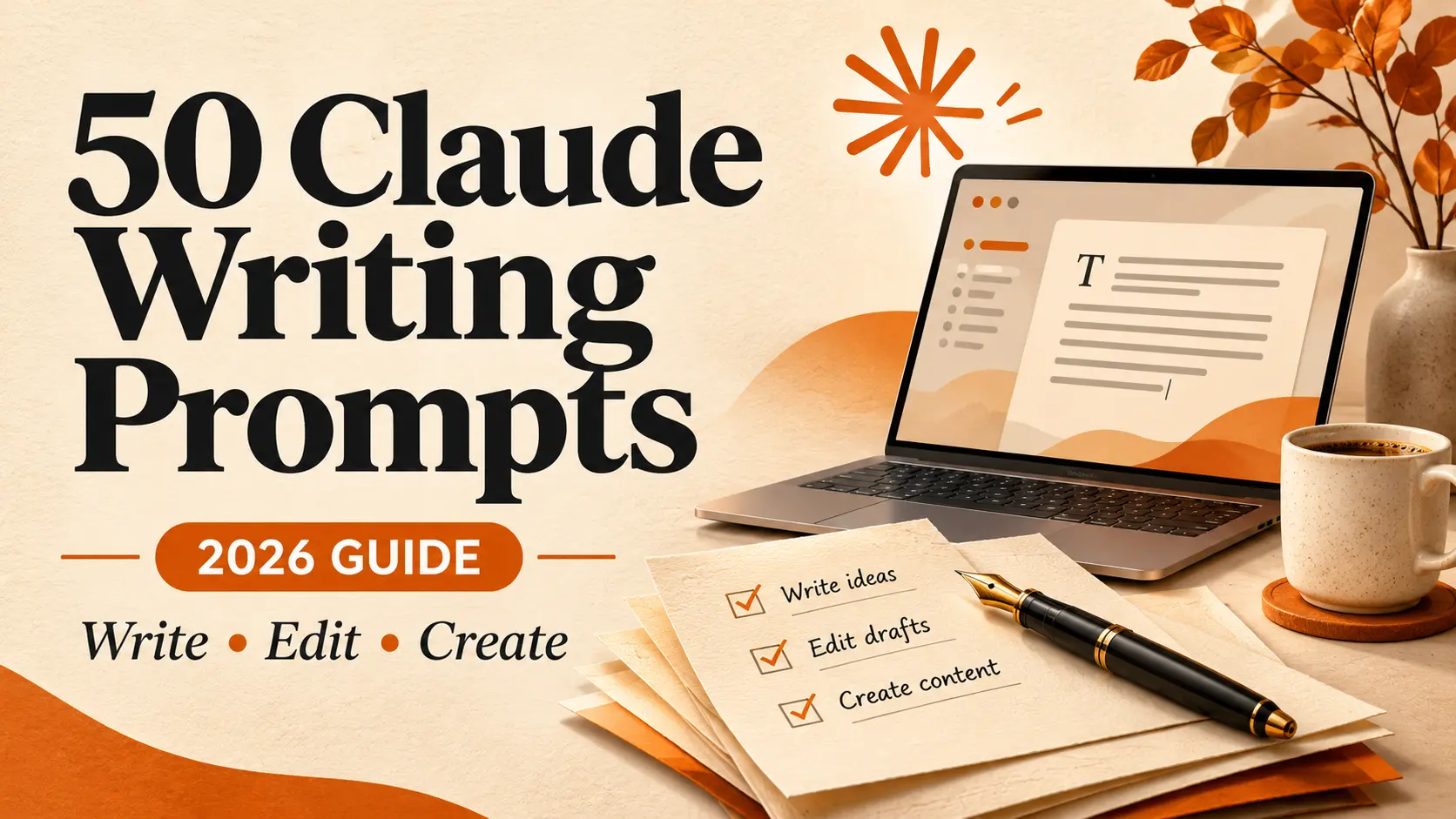
50 Best Claude Writing Prompts for Writing in 2026
You open a document, write a sentence, delete it, and start again. Your idea makes sense in your head, but getting it onto the page feels harder than it should.
Claude can help you move past that moment. The challenge is giving it enough direction to produce something useful. Ask for “a good blog post,” and you leave your audience, purpose, and voice undefined.
These 50 Claude writing prompts give you practical starting points for articles, stories, emails, and more. Replace the bracketed details with your information, review the response, and shape the draft into something you would confidently publish.
How to Get Better Results From Claude Writing Prompts

You get a clearer starting point when your instructions explain the task, audience, and expected output. Anthropic’s guidance similarly recommends clear, specific instructions. support.claude.com
Before copying a prompt, gather these details:
| Prompt ingredient | What you should provide |
|---|---|
| Purpose | What your writing needs to achieve |
| Audience | Who you want to reach |
| Context | Relevant facts, notes, or examples |
| Voice | How you want the writing to sound |
| Format | Length, structure, and required elements |
Add Your Sources and Writing Samples
Provide source material when accuracy matters. Include a paragraph you wrote when you want a familiar voice.
A Useful Default Instruction
Add: “Use the supplied facts. Flag missing information, preserve important qualifications, and avoid inventing statistics or personal experiences.”
Claude Writing Prompts for Ideas and Outlines
When your thoughts feel scattered, start by deciding what your piece should accomplish.
- Fresh angles: “Suggest five distinct angles on [topic] for [audience], explaining the reader benefit of each.”
- Article outline: “Organize [notes] into an article outline with descriptive headings and a logical progression.”
- Reader questions: “Suggest questions a beginner might have about [topic]. Label these as ideas requiring validation.”
- Central argument: “Propose three central arguments for [topic] and identify the evidence each would need.”
- Writing block: “Ask me five questions about [idea], then wait before helping me outline it.”
Claude AI Prompts for Blog Posts and SEO

Use these templates to organize useful content around your reader’s needs. Supply keyword research separately rather than treating generated suggestions as search data.
- Search-focused structure: “Outline an article targeting [keyword], using [research] to address your reader’s main questions.”
- Introduction: “Write three introductions to [topic], each addressing a specific frustration experienced by [audience].”
- Section draft: “Draft [section heading] using [verified notes], with a clear explanation and practical example.”
- SEO metadata: “Suggest five accurate titles and meta descriptions for [article], incorporating [keyword] naturally.”
- Content gaps: “Compare [draft] with [reader requirements]. Identify unanswered questions and unnecessary sections.”
Claude Prompts for Creative Writing

You can use Claude to explore possibilities while keeping control of your characters, themes, and narrative choices.
- Character development: “Develop a [genre] character with conflicting desires, a believable weakness, and a difficult decision.”
- Plot structure: “Outline a story about [premise], connecting each major event to the protagonist’s choices.”
- Dialogue: “Revise [dialogue] so both characters have distinct voices and conflicting unstated intentions.”
- Setting: “Describe [location] through [character]’s perspective, choosing sensory details that reflect their mood.”
- Scene revision: “Identify pacing problems in [scene], then suggest changes that preserve its emotional purpose.”
Claude Writing Prompts for Marketing Copy
Give Claude your actual product details, customer concerns, and policies before asking it to persuade anyone.
- Landing page: “Draft a landing page for [offer], using [verified benefits] and one clear call to action.”
- Product description: “Turn [specifications] into a product description connecting features with relevant everyday benefits.”
- Ad variations: “Write five advertising variations for [offer], each using a different supported selling point.”
- Value proposition: “Create three value propositions using [customer research], without inventing advantages over competitors.”
- Objections: “Address [customer concerns] using [product facts and policies], without unsupported promises.”
Claude Prompts for Emails and Newsletters
Your emails need a clear purpose and a next step that makes sense to the recipient.
- Welcome email: “Welcome subscribers to [newsletter], explain what to expect, and deliver [promised resource].”
- Outreach: “Draft a concise email to [recipient] explaining why [offer] relates to [verified context].”
- Newsletter: “Turn [notes] into a newsletter with one central theme and three useful takeaways.”
- Follow-up: “Follow up on [email], adding [helpful information] without pressure or artificial urgency.”
- Customer update: “Explain [service issue], acknowledge its impact, and share only confirmed next steps.”
Claude Writing Prompts for Social Media
Adapt your message to the format rather than repeating the same paragraph everywhere.
- LinkedIn post: “Turn [real professional experience] into a LinkedIn post with a specific, useful lesson.”
- Instagram captions: “Write five captions for [image], matching [brand voice] without exaggerated claims.”
- Carousel: “Convert [source material] into seven slides, giving each slide one clear takeaway.”
- Video script: “Write a short script explaining [topic], with an opening hook and practical demonstration.”
- Post series: “Create five standalone posts from [article], each exploring a different supported insight.”
Claude Prompts for Professional Writing
Use original documents so your summaries and recommendations stay connected to the available evidence.
- Executive summary: “Summarize [report] for [decision-maker], preserving key findings, uncertainties, and relevant figures.”
- Proposal: “Draft a proposal from [brief], covering objectives, scope, deliverables, assumptions, and unresolved questions.”
- Meeting update: “Organize [meeting notes] into decisions, blockers, and actions, retaining supplied owners and deadlines.”
- Instructions: “Convert [process notes] into numbered instructions for beginners, flagging missing operational details.”
- Recommendation: “Compare [options] against [criteria], separating documented evidence from assumptions.”
Claude Writing Prompts for Editing
A focused editing request makes it easier to judge whether the revision actually improves your draft.
- Clarity: “Edit [draft] for clarity while preserving meaning. Explain any substantial changes.”
- Conciseness: “Shorten [draft] by approximately 20%, retaining essential facts and qualifications.”
- Your voice: “Use [my writing samples] to revise [draft] while preserving its factual content.”
- Specificity: “Flag vague statements in [draft] and identify where concrete examples would help.”
- Source checking: “Compare [draft] with [sources], listing contradictions and claims these sources cannot verify.”
Claude Prompts for Recipes and Lifestyle Content
Supply tested recipe notes. Treat generated additions as suggestions requiring review.
- Recipe article: “Format [tested recipe] with servings, an ingredient table, and numbered instructions.”
- Ingredients: “Organize [ingredients] by quantity, preparation, and recipe step. Flag missing amounts.”
- Substitutions: “Explain [tested substitutions], including their documented effects on texture and flavor.”
- Practical guide: “Turn [notes] into a beginner’s guide to [activity], including supplies and common mistakes.”
- Recipe introduction: “Introduce [recipe] through its actual flavors and textures, without invented personal history.”
Claude Prompts for Repurposing Content
- Article to email: “Adapt [article] into a concise newsletter retaining its main takeaway.”
- Transcript to article: “Organize [transcript] into an article, preserving meaning and accurately marking quotations.”
- Ebook chapter: “Combine [articles] into one chapter, removing repetition and flagging inconsistencies.”
- New audience: “Adapt [content] for [audience], adjusting terminology without changing the facts.”
- Content refresh: “Compare [older article] with [updated sources], identifying outdated claims and unresolved questions.”
FAQ About Claude Writing Prompts
What Are the Best Claude Writing Prompts for Beginners?
Start with outlining, summarizing your notes, or improving a paragraph. These focused tasks give you outputs you can easily evaluate.
Can You Use Claude Writing Prompts for SEO?
Yes, for briefs, drafts, and revisions. You still need reliable research, useful information, and editorial judgment; prompts cannot guarantee rankings.
How Do You Keep Your Writing Personal?
Provide your own examples and experiences. Revise anything you would not naturally say.
Conclusion: Put One Prompt to Work
Choose the Claude writing prompt that matches your unfinished task. Add your context, generate a draft, and review it carefully. Try one today, then share which prompt helped—and what you changed to make the result yours.