
Beauty Close-Up Prompt: Create Realistic Skin Texture in AI Portraits
Beauty Close-Up Prompt Skin Texture Realistic: How You Create AI Portraits That Feel Truly Human
When you zoom in on a face, everything changes. Skin stops being a smooth surface and becomes a landscape—pores, fine lines, subtle shadows, tiny imperfections that tell a story. If your AI portraits still look polished, plastic, or unreal, you’re not doing anything wrong. You’re just missing the language that teaches the model how real skin behaves.
In this guide, you’ll learn how to write a beauty close-up prompt with realistic skin texture that produces portraits that feel authentic, intimate, and believable. You’ll understand not only what to write, but why it works—so you can adapt the technique to any AI image tool you use.
What “Realistic Skin Texture” Actually Means in Beauty Close-Ups
Before you improve your prompts, you need clarity on the goal.

Realistic skin texture is not about flaws for the sake of flaws. It’s about visual honesty. In real close-up photography, skin shows:
- Visible pores
- Fine lines around eyes and mouth
- Slight unevenness in tone
- Natural softness mixed with sharp detail
- Light interacting with micro-textures
When these elements are missing, the brain instantly reads the image as artificial. That’s why many AI portraits feel emotionally flat, even when they look “perfect.”
Your job is to guide the model toward human detail, not idealized smoothness.
Why Beauty Close-Up Prompts Fail Without Skin Texture
Most default AI prompts unintentionally erase realism. Words like flawless, perfect skin, or beauty retouch push the model toward an airbrushed aesthetic. That might work for fantasy art, but it breaks immersion in close-up portraits.
Here’s what usually goes wrong:
- The face looks waxy or doll-like
- Skin appears blurred instead of detailed
- Lighting flattens facial features
- The portrait feels distant, not intimate
Once you understand this, the fix becomes simple: you replace vague beauty language with specific sensory detail.
Core Elements of a Beauty Close-Up Prompt with Realistic Skin Texture
A strong prompt follows a logical structure. Think of it as building a photograph in words.

1. Subject Description (Keep It Natural)
Instead of dramatic or exaggerated descriptions, anchor the subject in reality.
Examples:
- natural female portrait
- adult male face, neutral expression
- relaxed facial muscles, calm mood
Avoid over-styling. The closer the portrait, the more restraint matters.
2. Skin Texture Language (This Is the Key)
This is where realism is won or lost. You should clearly describe what real skin does, not what beauty ads promise.
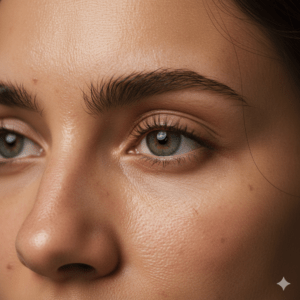
Use phrases like:
- visible skin pores
- fine lines and micro-details
- natural skin texture
- subtle imperfections
- realistic facial skin detail
- uneven skin tone, soft highlights
These terms tell the model to add information, not remove it.
3. Camera and Lens Details
Close-up realism improves dramatically when you anchor the image in photography.
Effective descriptors include:
- macro portrait photography
- 85mm lens
- shallow depth of field
- sharp focus on skin texture
This shifts the AI’s reference point from illustration to real photography.
4. Lighting That Reveals Texture
Lighting decides whether texture is visible or erased.
Best options:
- soft natural window light
- side lighting
- diffused studio lighting
- gentle shadows across the face
Avoid harsh frontal light—it flattens the skin and kills detail.
Example of a Well-Structured Beauty Close-Up Prompt
Here’s how all elements come together naturally:
Beauty close-up AI portrait of a woman, natural expression, macro photography, 85mm lens, soft window light from the side, visible pores, fine lines, realistic skin texture, subtle imperfections, shallow depth of field, ultra-detailed, natural color tones.
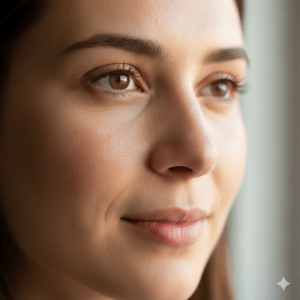
Notice how nothing feels forced. The realism comes from clarity, not complexity.
The “Prompt Recipe” for Realistic Skin Texture
Think of your prompt like a recipe. Each ingredient has a role.
| Ingredient | What You Add | Why It Matters |
|---|---|---|
| Subject | Natural face description | Grounds the portrait |
| Skin texture | Pores, fine lines, imperfections | Creates realism |
| Camera | Macro, 85mm lens | Adds photographic logic |
| Lighting | Soft, directional light | Reveals texture |
| Quality | High detail, realistic tones | Enhances final output |
When one ingredient is missing, realism drops.
Common Mistakes That Ruin Skin Realism
Even experienced creators fall into these traps.
Over-Smoothing the Skin
Words like perfect, airbrushed, or beauty retouch tell the AI to erase texture.
Conflicting Instructions
Combining ultra-realistic skin texture with anime style or fantasy glow confuses the model.
Forgetting Negative Guidance
If you don’t tell the AI what to avoid, it fills the gaps itself.
Helpful negative phrases include:
- no plastic skin
- no doll-like face
- no excessive smoothing
Advanced Techniques for Ultra-Realistic Beauty Close-Ups
Once you master the basics, small refinements make a big difference.
Use Material Language
Skin is a surface. Treat it like one.
Try adding:
- natural skin material
- organic texture
- realistic surface detail
Control Color and Tone
Real skin is never pure.
Descriptors like:
- natural skin tones
- subtle color variation
- soft highlights and shadows
add depth without drama.
SEO Optimization Without Breaking the Flow
To rank well, keywords matter—but subtlety matters more.
You should naturally include phrases like:
- beauty close-up prompt skin texture realistic
- beauty close-up AI portrait prompt
- realistic skin texture AI portrait
Best places to use them:
- Headings
- First 150 words
- One or two subheadings
- FAQ section
Avoid repetition for repetition’s sake. Search engines reward clarity and usefulness.
Frequently Asked Questions
What is the best beauty close-up prompt for realistic skin texture?
The best prompt combines natural subject description, visible skin detail, realistic lighting, and photographic language. Avoid words that imply perfection or heavy retouching.
Why does my beauty close-up prompt still look fake?
Most often, it’s due to missing skin texture keywords or lighting that flattens detail. Adding pores, fine lines, and side lighting usually fixes the issue.
Can AI really create realistic skin texture?
Yes. When guided properly, AI models can produce skin detail that closely resembles professional macro photography.
Conclusion: Real Beauty Lives in the Details
When you work on beauty close-up prompts, you’re not chasing perfection—you’re chasing honesty. Real skin has texture. It reflects light unevenly. It carries age, emotion, and individuality.
Once you start writing prompts that respect those truths, your AI portraits change instantly. They feel closer. More human. More believable.
Your Next Step
Take one of your old beauty prompts today. Remove one “perfect” word. Add one texture detail. Adjust the lighting. Generate again—and compare.
If this guide helped you, save it, share it, and experiment. The more you practice writing for realism, the more your images will stand out in a sea of polished sameness.