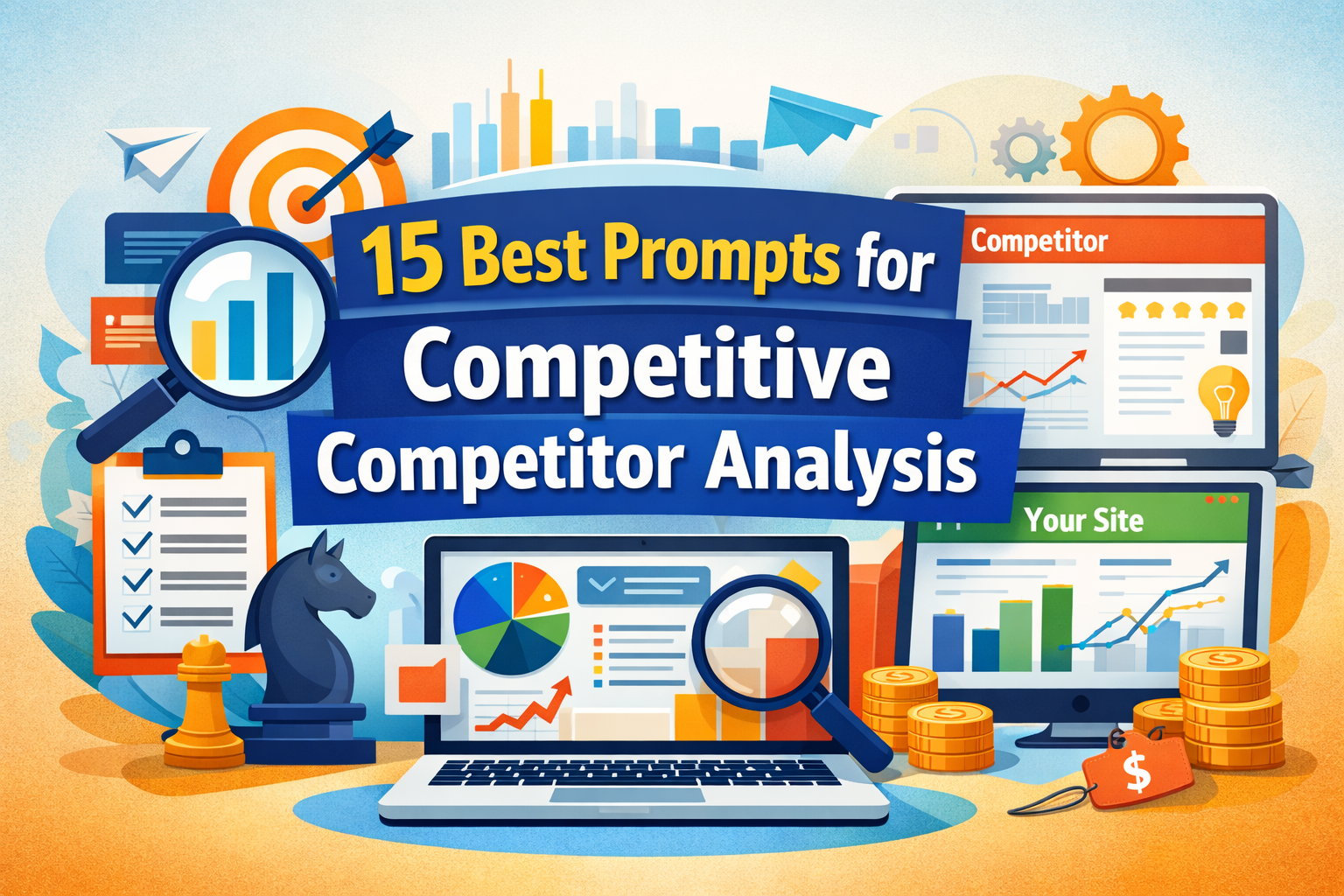
15 Best Prompts for Competitive Competitor Analysis in 2026
15 Best Prompts for Competitive Competitor Analysis Staying ahead of your competitors is no longer about guessing, copying, or reacting too late. Today, the brands that win are the ones that understand their competitors deeply—their strategies, weaknesses, positioning, and blind spots. If you’ve ever felt overwhelmed trying to analyze competitors manually, you’re not alone.
That’s where smart prompts come in.
With the right prompts, you can turn scattered data into clear insights, uncover opportunities others miss, and make confident decisions without drowning in spreadsheets or tools. This guide walks you through the 15 best prompts for competitive competitor analysis, showing you how to think strategically, not just collect information.
Why Competitive Competitor Analysis Matters More Than Ever
Markets are louder than they’ve ever been. New brands appear daily, content saturation keeps rising, and customer attention is harder to earn. If you don’t actively analyze your competitors, you risk:
- Pricing yourself incorrectly
- Targeting the wrong audience
- Creating content nobody searches for
- Building features customers don’t care about
Competitive competitor analysis helps you understand where you stand, where the gaps are, and how to move smarter instead of faster.
When done right, it answers questions like:
- Why are they ranking higher than you?
- Why do customers choose them?
- What are they ignoring that you can own?
What Makes a Strong Competitor Analysis Prompt
Before jumping into the prompts, it’s important to know what separates a powerful prompt from a useless one.
A strong competitor analysis prompt should:
- Be specific, not generic
- Focus on insights, not descriptions
- Encourage comparison, not imitation
- Lead to actionable decisions
You’re not trying to copy competitors—you’re trying to outthink them.
The 15 Best Prompts for Competitive Competitor Analysis
Below are carefully structured prompts grouped by strategy area. Each one serves a different business purpose.
Market Positioning & Brand Strategy Prompts
- Analyze how my top competitors position themselves and identify messaging gaps I can exploit.
Helps you differentiate instead of blending in. - Compare competitor value propositions and highlight what they overpromise or underdeliver.
Reveals credibility gaps you can turn into trust. - Identify underserved customer segments based on competitor targeting strategies.
Perfect for niche expansion.
SEO & Content Competitor Analysis Prompts
- Analyze competitors’ top-ranking pages and identify common keyword patterns and intent.
Shows you what search engines already reward. - List content topics competitors rank for that my website does not cover.
Your roadmap for fast SEO wins. - Compare content depth, structure, and freshness across top competitors.
Helps you outperform instead of just matching.
Product & Feature Comparison Prompts
- Compare competitor product features and identify missing or weak functionality.
Ideal for product-led growth. - Analyze negative customer reviews of competitors to uncover recurring pain points.
Customers tell you exactly what to fix—if you listen. - Track how competitor features have evolved over time and what that signals about demand.
Predicts where the market is heading.
Pricing & Monetization Strategy Prompts
- Analyze competitor pricing models and identify psychological pricing techniques they use.
Helps you price with confidence. - Compare free vs paid feature distribution across competitors.
Useful for SaaS and freemium models. - Identify upsell, cross-sell, and bundle strategies competitors use to increase revenue.
Unlocks hidden revenue opportunities.
Customer Experience & Trust Prompts
- Analyze competitor onboarding experiences and identify friction points.
Improves retention from day one. - Compare trust signals competitors use (social proof, guarantees, authority).
Helps you convert hesitant buyers. - Evaluate competitor customer support tone, speed, and accessibility.
Service quality is often the easiest advantage to win.
How to Turn Prompts into Actionable Insights
Prompts alone won’t move your business forward unless you apply them correctly.
Here’s how to use them effectively:
- Focus on patterns, not isolated examples
- Document insights in a shared strategy file
- Translate findings into clear actions
- Re-run analysis quarterly to track shifts
Think of competitor analysis as a living process, not a one-time task.
Common Mistakes to Avoid in Competitive Competitor Analysis
Many businesses fail at competitor analysis because they:
- Copy strategies without context
- Obsess over competitors instead of customers
- Analyze too much and act too little
- Ignore long-term positioning
Your goal isn’t to chase competitors—it’s to outgrow them.
FAQs About Competitive Competitor Analysis
What are the 15 best prompts for competitive competitor analysis?
They are structured prompts designed to analyze competitor positioning, content, pricing, product features, and customer experience in a strategic, actionable way.
How often should you run competitive competitor analysis?
Ideally every quarter, with lighter monthly check-ins for SEO and pricing changes.
Can competitor analysis improve SEO rankings?
Yes. Understanding competitor keywords, content structure, and gaps directly improves your SEO strategy.
Is competitive competitor analysis useful for small businesses?
Absolutely. Smaller teams benefit the most because smart analysis saves time, money, and effort.
Conclusion: Turn Competitor Insights into Your Advantage
Competitive competitor analysis isn’t about obsession—it’s about clarity. When you understand what your competitors are doing, where they fall short, and what customers really want, you stop guessing and start leading.
The 15 best prompts for competitive competitor analysis give you a structured way to uncover opportunities, sharpen your strategy, and build a brand that stands out instead of blends in.
Your Next Move (Call to Action)
Choose one prompt today, apply it to your top competitor, and document what you learn. Then turn that insight into action—whether it’s a new piece of content, a pricing adjustment, or a clearer message.
Smart businesses don’t compete harder.
They compete smarter.
If you want, I can:
- Create meta title, description & URL
- Generate a featured image prompt
- Adapt this article for SaaS, eCommerce, or content sites
Just tell me 🚀