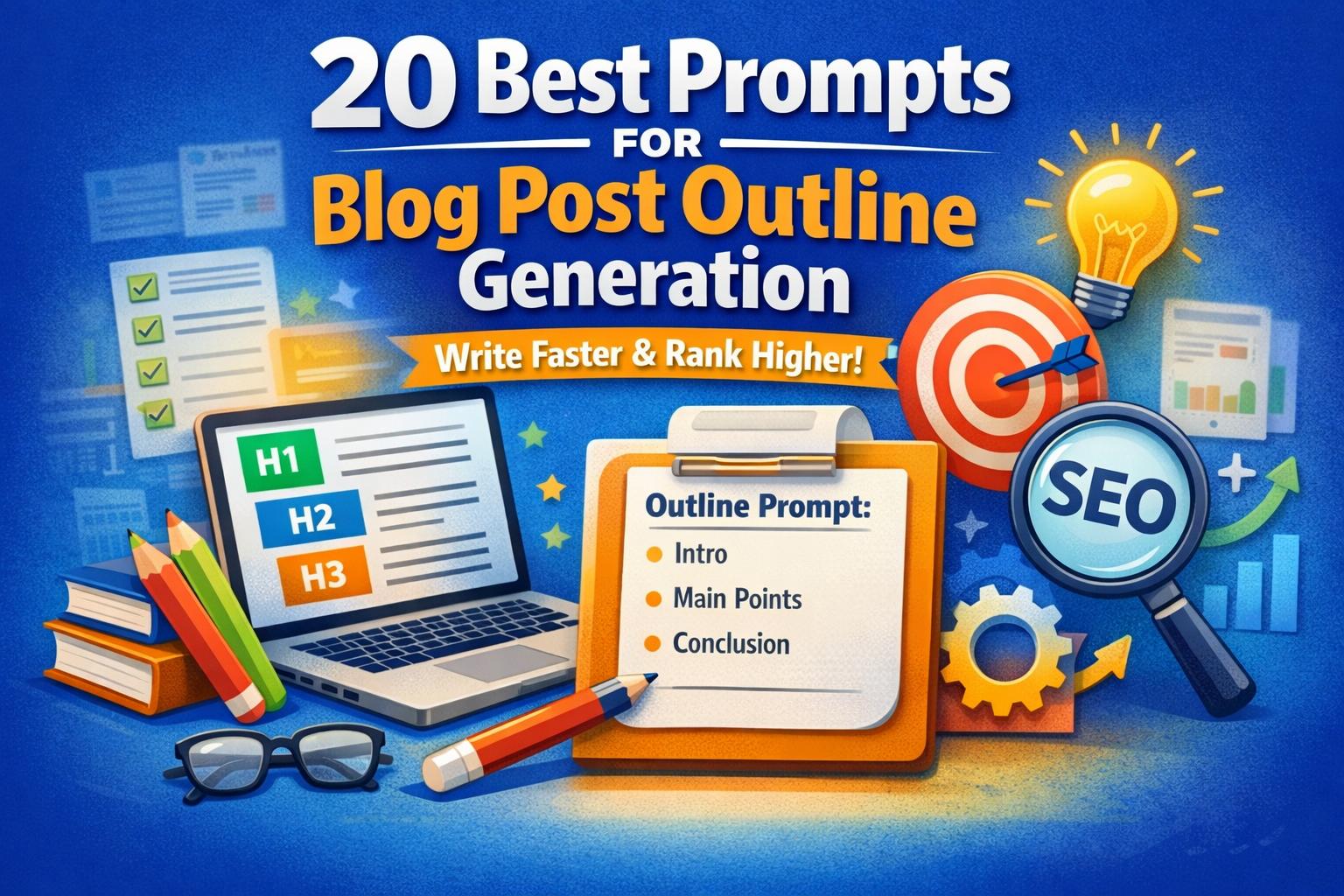
20 Best Prompts for Blog Post Outline Generation
Master Your Content Strategy: 20 Best Prompts for Blog Post Outline Generation We’ve all been there: staring at a blinking cursor, the white space of a blank document feeling more like a wall than a canvas. You have a great idea, the expertise is there, but the bridge between “thought” and “finished draft” feels miles long. It’s exhausting to spend hours wrestling with structure when you just want to share your voice with the world.
The secret isn’t working harder; it’s about starting smarter. Using AI to build your skeleton allows you to reclaim your creative energy for the storytelling that matters. This guide is your roadmap to bypassing writer’s block forever by utilizing the 20 Best Prompts for Blog Post Outline Generation.
Why Your Content Needs a Solid Foundation
Before you dive into the prompts, you need to understand why an outline is the “unsung hero” of SEO. Without a map, you’re just wandering through a forest of words. A structured outline ensures:
Logical Flow: It keeps your readers on the page longer, which tells search engines your content is valuable.
Semantic Depth: It helps you cover all the sub-topics related to your main keyword, making your piece more “authoritative.”
Efficiency: You can slash your drafting time by 50% or more because you’ve already done the heavy lifting of organization.
20 Best Prompts for Blog Post Outline Generation
Below is a curated list of prompts categorized by the type of content you are creating. These aren’t just simple questions; they are engineered instructions designed to get the most “human-like” and strategic responses from your AI partner.
A. Foundational & General Purpose
These prompts are the “Swiss Army Knives” of content creation. Use them when you have a broad topic and need a standard, high-ranking structure.
The Comprehensive Guide: “Act as a seasoned SEO strategist. Create a detailed blog post outline for [Topic]. Include a hook-driven introduction, five distinct H2 sections, and a conclusion that drives action. Target [Specific Audience].”
The Beginner’s Roadmap: “Write an outline for a ‘Beginner’s Guide to [Topic].’ Prioritize foundational definitions and a logical ‘step-one, step-two’ progression that doesn’t overwhelm a novice.”
The Advanced Deep-Dive: “Develop a technical outline for [Topic] aimed at industry veterans. Bypass the basics and focus on [Specific Sub-topic], emerging data, and future predictions.”
B. Listicles & Comparison Posts
List-based content remains a powerhouse for driving clicks and social shares.
The Classic Listicle: “Generate an outline for ’10 Best [Product/Service] for [Year].’ For each entry, create placeholders for key features, pricing, and a ‘Who This Is For’ section.”
The Versus Battle: “Create a comparison outline for [Product A] vs. [Product B]. Structure it by comparing specific categories like durability, cost-effectiveness, and user interface.”
The ‘Best Of’ Round-up: “Outline a post titled ‘The Top 7 Tools for [Task].’ Include a section at the start explaining the methodology used for selection.”
C. Problem-Solving & Educational
This is where you build trust with your audience by solving their most pressing issues.
The Pain Point Solver: “My readers are struggling with [Problem]. Outline a post that empathizes with this struggle and offers five actionable, low-cost solutions.”
The Myth Buster: “Outline a blog post that identifies and deconstructs five common misconceptions about [Topic]. Each section should provide the ‘Myth’ followed by the ‘Evidence-Based Reality’.”
The Case Study: “Draft an outline for a case study post showing how [Product/Service] helped a client achieve [Result]. Focus on the ‘Before,’ the ‘Implementation,’ and the ‘After’.”
D. Creative & Engaging Formats
To stand out in a sea of generic content, you need a unique angle.
The Storyteller: “Outline a post using a narrative arc about [Topic]. Start with a relatable conflict, move to a turning point involving [Solution], and end with the moral of the story.”
The ‘Mistakes to Avoid’: “Generate an outline for ‘7 Fatal Mistakes People Make with [Topic].’ Focus on the ‘why’ behind the mistake and provide a checklist for recovery.”
The Checklist Style: “Create an outline that acts as a comprehensive, printable-style checklist for [Process]. Break it down into pre-launch, execution, and post-launch phases.”
E. Specialized Niche Prompts
Sometimes you need a specific framework for a specific industry.
The Recipe Outline: “Create a blog outline for [Dish Name]. Include a table for ingredients, a section for common substitutions, and a troubleshooting guide for the cooking process.”
The Product Review: “Outline a comprehensive review for [Product Name]. Ensure there is a section for ‘What’s in the Box’ and a final ‘The Verdict’ summary.”
The Interview Synthesis: “Outline a blog post based on an interview with [Expert]. Structure it around five central themes discussed during the conversation.”
The Trend Update: “Outline a post about the recent changes in [Industry]. Discuss what happened, why the old way is dead, and how to adapt to the new standard.”
The FAQ-Based Post: “Using the 20 Best Prompts for Blog Post Outline Generation as a primary theme, create an outline based on the top 10 questions found on Reddit or Quora about [Topic].”
The ‘Alternative To’ Post: “Outline a post for ‘Best Alternatives to [Popular Software].’ Focus on features that the market leader lacks, specifically [Feature].”
The Thought Leadership Piece: “Draft an outline for a provocative opinion piece on why [Current Industry Practice] is outdated. Use a ‘Challenge-and-Solution’ framework.”
The Resource Library: “Outline a post that curates the absolute best books, podcasts, and courses for mastering [Skill] in under six months.”
Formatting for Success: The Strategy Blueprint
When you use the 20 Best Prompts for Blog Post Outline Generation, you aren’t just looking for text. You are looking for a visual layout that keeps readers engaged. In certain niches, like cooking or technical reviews, tables are non-negotiable for clarity.
Sample Outline Component Table
| Component | Function | SEO Value |
| H1 Headline | Hooks the reader | High (Primary Keyword) |
| Bullet Points | Increases readability | Medium (User Experience) |
| Internal Links | Connects related ideas | High (Crawlability) |
| Conclusion/CTA | Drives conversions | High (Business Value) |
How to Refine Your AI-Generated Outlines
An AI-generated outline is like a rough sketch. To turn it into a masterpiece, you must apply your human touch. Here’s how you can elevate any outline:
Inject Personal Experience: AI doesn’t have a life. You do. Add a section for “My Personal Experience with X” to boost your E-E-A-T (Experience, Expertise, Authoritativeness, Trustworthiness).
Optimize for Snippets: Look for sections where you can provide a direct 50-word answer to a question. This helps you rank for “Position Zero” on Google.
Add Visual Cues: Note where you should place images, infographics, or videos. A wall of text is a reader’s enemy.
Refine the H3s: Don’t just settle for what the AI gives you. Make sure your subheadings are catchy and include secondary keywords.
Conclusion
The era of staring at a blank screen is over. By mastering the 20 Best Prompts for Blog Post Outline Generation, you are giving yourself the gift of time and the power of precision. Whether you are writing a technical deep-dive or a simple recipe, these frameworks provide the skeleton you need to build content that ranks and resonates.
Don’t let your great ideas die in the “draft” folder. Use these prompts to build your next viral post today.
Frequently Asked Questions (FAQ)
What are the 20 Best Prompts for Blog Post Outline Generation?
The 20 best prompts are specific, engineered sets of instructions that guide AI to create structured, SEO-optimized outlines for various content types, from listicles to technical guides.
Why should I prioritize an outline over just writing?
An outline ensures you cover all relevant sub-topics, which is crucial for ranking in modern search engines that prioritize “topical authority” over simple keyword stuffing.
Can these prompts help with AI detection?
Absolutely. By using structured prompts that demand specific formats, tables, and unique perspectives, you move away from the generic “AI voice” and create something that feels more deliberate and human-led.
How do I use these prompts for a recipe blog?
Use Prompt #13. It specifically asks for a table of ingredients and troubleshooting tips, which are essential for both user experience and ranking in Google’s recipe snippets.